

Force Plate Explained: How It Measures Ground Reaction Force, Center of Pressure and Impulse
Quick answer
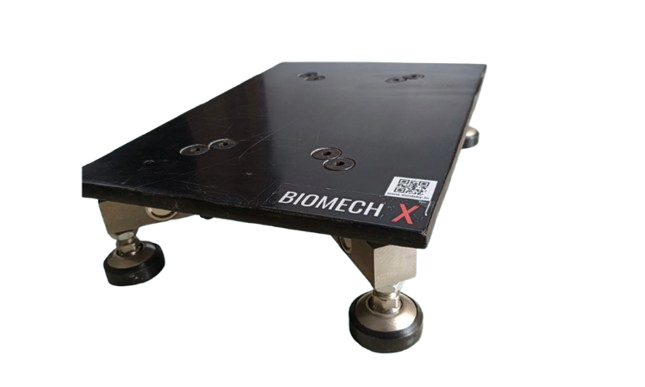
A force plate is a sensor-equipped plate that measures the ground reaction forces and moments produced by a body standing or moving on it. From these readings, software calculates force, center of pressure (CoP) and impulse.
- Measures three-dimensional force (Fx, Fy, Fz) and the moments around the plate.
- Used in biomechanics, sports science, rehabilitation and ergonomics.
- BioMechX, from Medsby in Coimbatore, streams data over Wi-Fi and lets you download it for Python analysis.
Medical and sports equipment has evolved rapidly over the last decade, and the force plate is one of its quiet success stories. Despite its simple, flat appearance, it is a cornerstone technology in biomechanics, and it is also the building block of larger, more complex equipment.
What Is a Force Plate?
A force plate is a metal plate fitted with sensors that detect the forces and moments applied to its surface. It measures the ground reaction force: the force the ground pushes back with when you stand, walk, land or jump. When you stand or perform an action on the plate, it captures the three-dimensional forces (Fx, Fy and Fz) and the moments, or torques, around the centre of the plate. Those moments are what let software work out the center of pressure.
How Does a Force Plate Work?
A force plate works in three stages: mechanical input, transduction and signal processing.
1. Mechanical input
When a force is applied to the surface, it causes tiny mechanical changes in the sensors beneath the plate.
2. Transduction
The sensors convert that mechanical change into an electrical signal. Piezoelectric sensors generate an electric charge proportional to the applied force. Strain gauge sensors change their electrical resistance when they deform. Different force plates use different sensor types.
3. Signal processing
An analog-to-digital (A/D) converter turns the electrical signal into digital data. Software then interprets the data to calculate the magnitude and direction of the forces.
Force Plate Calculations: Force, Center of Pressure and Impulse
Once the raw data is available, three main outputs can be calculated: force, center of pressure (CoP) and impulse.
Total force
The total (resultant) force combines the three force components. Because they act in different directions, they are added as vectors:
In a vertical jump or a stand, Fz (the vertical component) dominates, so it is the main signal analysts study.
Center of pressure (CoP)
The center of pressure is the point where the total resultant force acts. It is calculated from the moments and the vertical force, using the forces measured at the plate’s four corners:
CoP values are essential for assessing postural stability and balance.
Impulse
Impulse comes from the impulse-momentum relationship:
Here J is the impulse, the area under the force-time curve. Integrating the net vertical force (force minus body weight) over time gives the change in momentum. Dividing by body mass gives the change in velocity, which reveals the body’s take-off velocity. Jump height then follows from h = v² / 2g.
Force Plate Applications in Rehabilitation and Sports
These calculations let clinicians measure the rate of force development and jump height, and identify imbalances between the legs after an injury. That gives them objective data to plan rehabilitation, and to judge whether a patient is ready to continue care or to walk and perform tasks independently.
- Rehabilitation: compare left and right leg loading and track recovery with numbers rather than impressions.
- Sports performance: document and analyse jumps and landings to optimise power training.
- Balance and posture: use CoP to assess stability in clinics and labs.
- Ergonomics and research: force plates can be customised for the purpose, from gait labs to student projects.
Force plates pair well with other sensing tools. See how motion is tracked with wearables in our guide to the IMU sensor and Motivus.
Medsby BioMechX: A Force Plate with Open Data
At Medsby we make a force plate called BioMechX (see also BioMechX V4). It works as a force plate and also lets third-party software use its data for analysis. As an example, here is how Python can analyse BioMechX force data.
Analysing jumps with Python
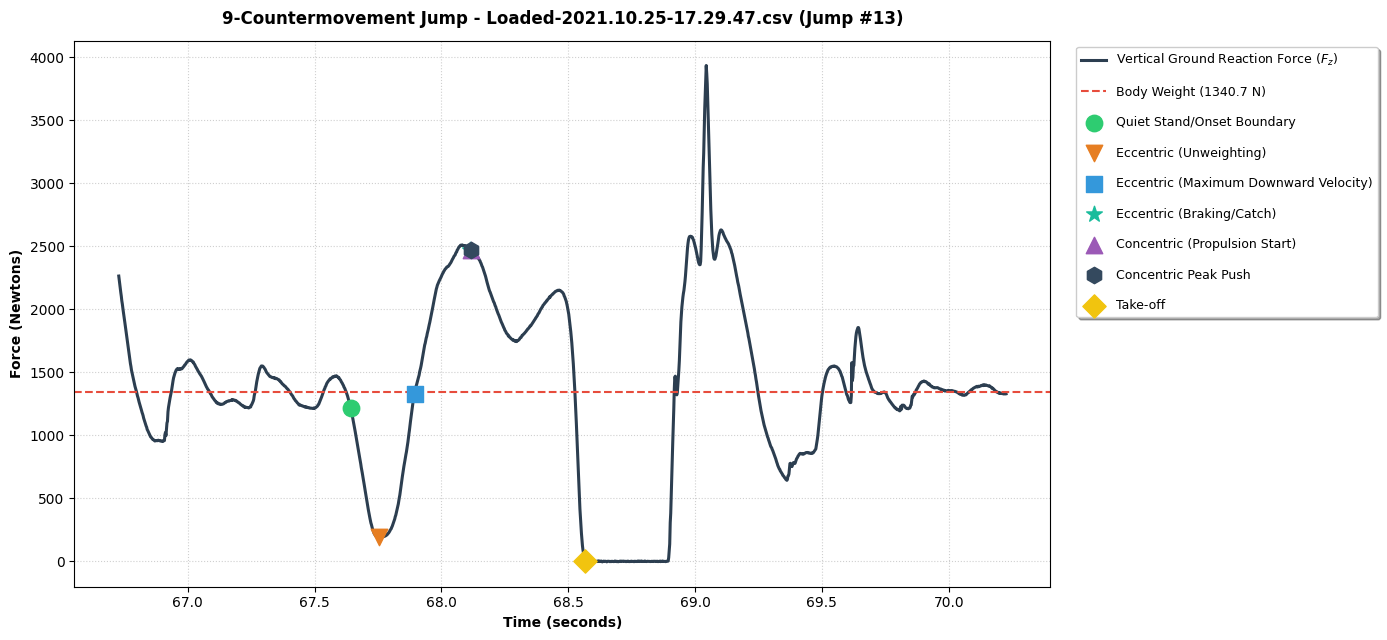
BioMechX connects over Wi-Fi, and its web app shows the raw data. You can download that data and run it through analysis code. The analysis code splits the recording into individual jumps, isolates one jump and shows the forces during it.
Reading the results
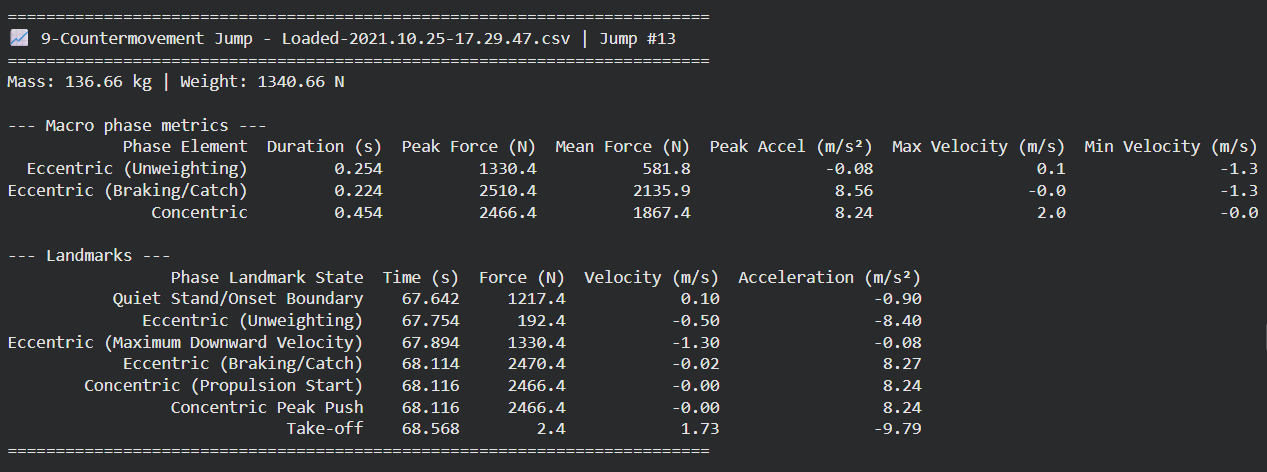
The calculations judge the quality of the jump and the forces applied. They give metrics such as peak eccentric and concentric force, and show whether the total force the body can apply meets a healthy threshold. The data below is from one countermovement jump (jump #13).
| Phase | Duration (s) | Peak force (N) | Mean force (N) | Peak accel. (m/s²) |
|---|---|---|---|---|
| Eccentric (unweighting) | 0.254 | 1330.4 | 581.8 | -0.08 |
| Eccentric (braking/catch) | 0.224 | 2510.4 | 2135.9 | 8.56 |
| Concentric | 0.454 | 2466.4 | 1867.4 | 8.24 |
Live data for games and apps
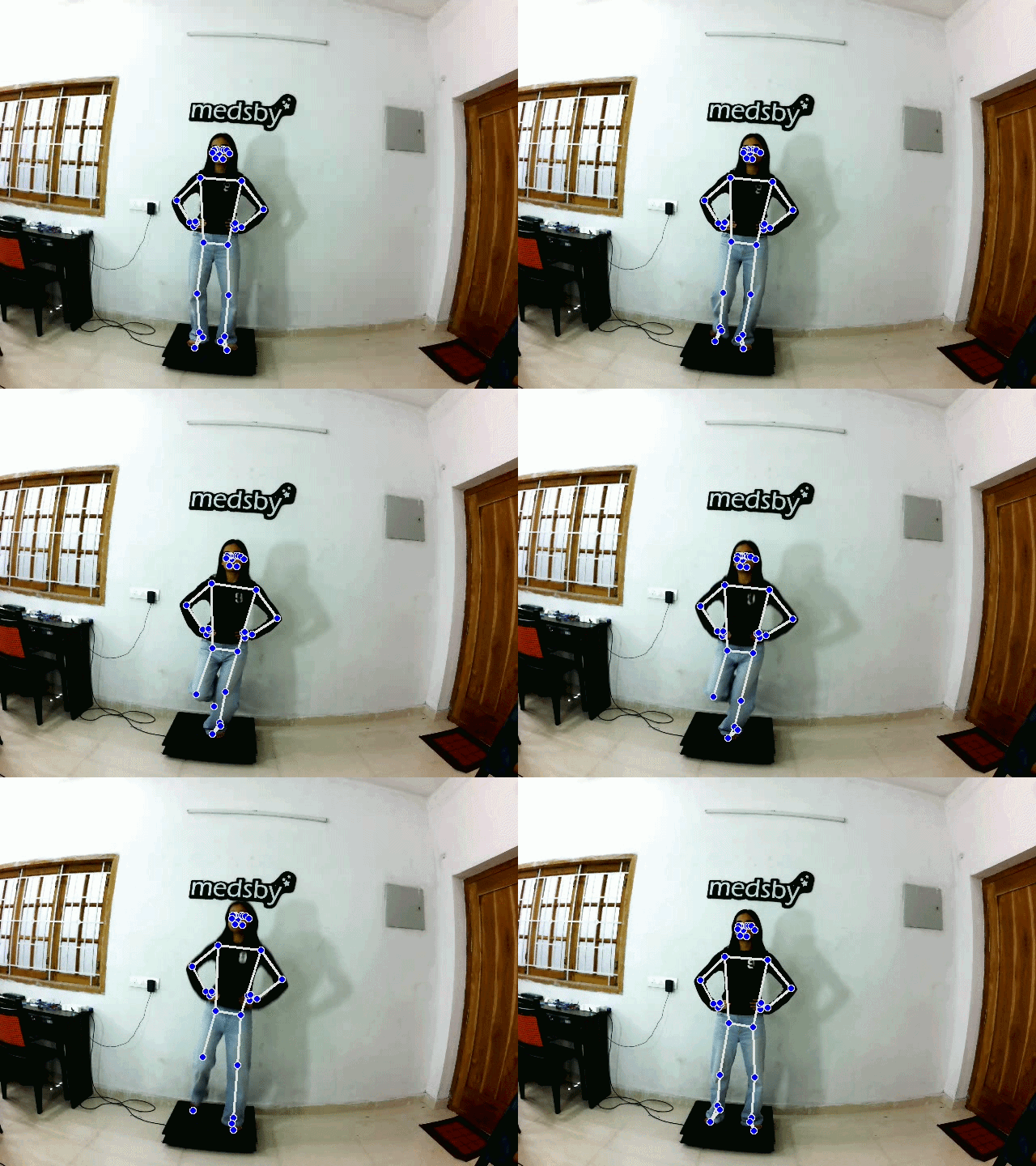
The force plate can also drive game mechanics using the live data from the web app. That makes BioMechX a versatile tool for clinics, labs, classrooms and interactive projects.
Force Plate Solutions from Coimbatore, Tamil Nadu
Medsby is a biomedical and engineering solutions company based in Coimbatore, Tamil Nadu, working with engineering colleges, researchers, clinics and innovators across India. If you are a physiotherapy clinic, sports science team or biomedical lab in Coimbatore, Chennai, Madurai or anywhere in Tamil Nadu looking for a force plate, our team can help with product guidance, set-up and training. Explore our biomechanics products, academic lab establishments and industrial training programmes.
Frequently Asked Questions
What is a force plate?
A force plate is a metal plate fitted with sensors that measure the ground reaction forces and moments produced by a person standing, jumping or moving on it. It is a core tool in biomechanics, sports science and rehabilitation.
How does a force plate work?
A force deforms the sensors under the plate, the sensors turn that deformation into an electrical signal, an analog-to-digital converter digitises it, and software calculates force, center of pressure and impulse.
What does a force plate measure?
It measures three-dimensional ground reaction forces (Fx, Fy, Fz) and the moments about the plate, from which center of pressure, impulse, peak force, rate of force development and jump height are calculated.
How is jump height calculated from a force plate?
The net vertical force (force minus body weight) is integrated over time to give impulse. Impulse divided by body mass gives the change in velocity, so take-off velocity is known and jump height follows from v² divided by 2g.
What is center of pressure and why does it matter?
Center of pressure is the point on the plate where the total ground reaction force acts. Tracking it shows postural stability and balance.
Where can I buy a force plate in India?
Medsby, based in Coimbatore, Tamil Nadu, offers the BioMechX force plate with delivery across India. It connects over Wi-Fi and lets you download raw data for your own analysis.
Can I use BioMechX data with Python or in games?
Yes. BioMechX streams data to a web app over Wi-Fi, the raw data can be downloaded for Python analysis, and the live data can also be used in game mechanics.

Project Engineering Intern, Medsby | Bioengineering student, University of Pittsburgh
Mithuna Saravanan is a bioengineering student at the University of Pittsburgh with a strong interest in biomechanics and medical innovation. At Medsby, she is gaining hands-on experience in engineering and healthcare technology, and she is passionate about learning how engineering can improve human health and movement.

Founder & CEO, Medsby Healthcare & Engineering Solutions
Guruprasandh is the founder of Medsby, a Coimbatore-based manufacturer and technology service provider established in 2014, specializing in wearable technology, healthcare devices, and 3D printing. With over a decade of experience in healthcare technology and engineering, he is committed to knowledge sharing, upskilling, and educational training for students and young innovators.
Keep exploring
Ready to measure real performance?
Talk to the Medsby team in Coimbatore about BioMechX, force plate set-ups or training for your lab, clinic or college anywhere in India.
View BioMechX Talk to our team