

IMU Sensor Explained: How Motion Tracking Works with Motivus and Blender
Quick answer
An IMU sensor (inertial measurement unit) tracks an object’s orientation, angular velocity and acceleration in 3D space. It combines an accelerometer and a gyroscope, and often a magnetometer, then uses sensor fusion to give stable roll, pitch and yaw angles.
- 9-DoF means accelerometer + gyroscope + magnetometer in one device.
- Used in physiotherapy, rehabilitation, VR headsets, drones and robotics.
- Motivus, from Medsby in Coimbatore, streams 9-DoF movement data that can drive a rigged model in Blender.
Sensors turn everyday physical events into data we can measure and improve. Proximity sensors dim your phone screen, optical sensors read room lighting and temperature sensors keep a refrigerator cold. In this guide, from our lab in Coimbatore, we look at one of the most useful of them all: the IMU sensor.
Human movement can be fast or slow, smooth or jerky. So how do we measure it? Strapped to a limb, an IMU records how that limb accelerates and rotates. That is why IMUs are used in physiotherapy, rehabilitation, VR headsets and drones.
What Is an IMU Sensor?
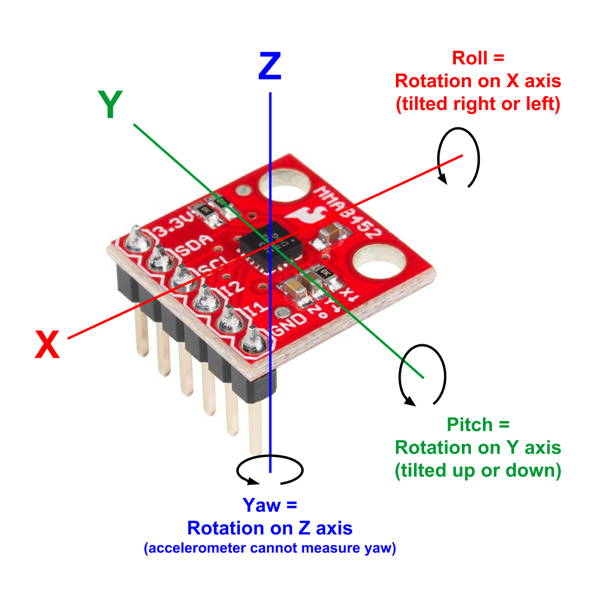
An IMU is a compact electronic module that measures how a body moves and rotates. It is built from two core sensors, an accelerometer and a gyroscope. Many modules also add a magnetometer. Together they describe motion across the three axes (X, Y and Z) and the three rotations: roll (rotation about X), pitch (rotation about Y) and yaw (rotation about Z).
What Is Inside an IMU Sensor?
Accelerometer: measures linear acceleration
Inside the chip, a microscopic silicon mass hangs on tiny silicon springs between fixed electrical plates, forming a capacitor. When the sensor accelerates along an axis, inertia makes the mass lag behind and shift relative to the plates. That shift changes the capacitance, and the chip converts the change into an analog voltage or digital value proportional to the acceleration.
An accelerometer also feels gravity. Sensor fusion software uses this gravity reading as a reference for “down”, then separates it from true movement when calculating motion.
Gyroscope: measures angular velocity
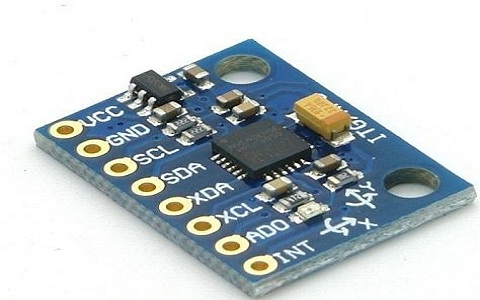
A gyroscope measures angular velocity, the rate of rotation around an axis, in degrees or radians per second. MEMS gyroscopes use the Coriolis effect. A tiny element is driven to vibrate at high frequency. When the IMU rotates, a Coriolis force acts perpendicular to that vibration and causes a secondary displacement of the mass. As in the accelerometer, this displacement changes capacitance, and the chip converts it into the rotation rate around a specific axis.
Magnetometer: the absolute heading reference
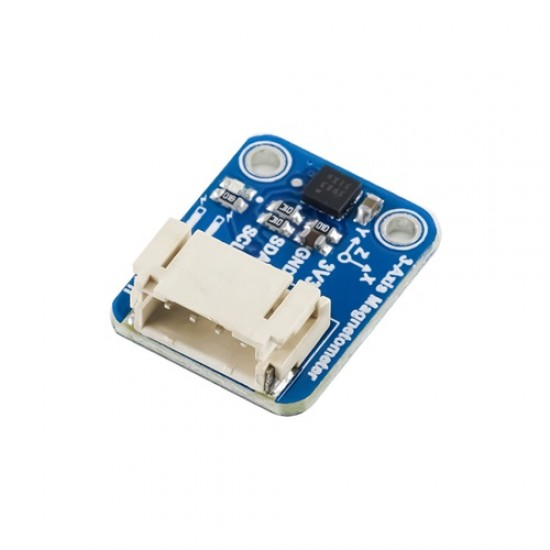
A magnetometer is not essential, but it noticeably improves accuracy. It measures the strength and direction of the local magnetic field, commonly with Hall-effect or magnetoresistive elements. That gives the IMU an absolute reference to magnetic North, which corrects heading errors such as yaw drift over time. Adding it makes the IMU a 9-DoF (nine degrees of freedom) device.
| Component | Measures | Strength | Weakness |
|---|---|---|---|
| Accelerometer | Linear acceleration and gravity | Stable at rest, gives true “down” | Noisy during impacts and vibration |
| Gyroscope | Angular velocity | Accurate for fast, dynamic moves | Drifts over time |
| Magnetometer | Magnetic field direction | Absolute heading, fixes yaw drift | Sensitive to nearby metal and magnets |
Sensor Fusion: From Noisy Numbers to Accurate Orientation
Raw IMU data is noisy. To turn it into usable kinematics, the IMU relies on sensor fusion algorithms, usually a complementary filter or an extended Kalman filter (EKF). The algorithm plays each sensor’s strengths against the others’ weaknesses.
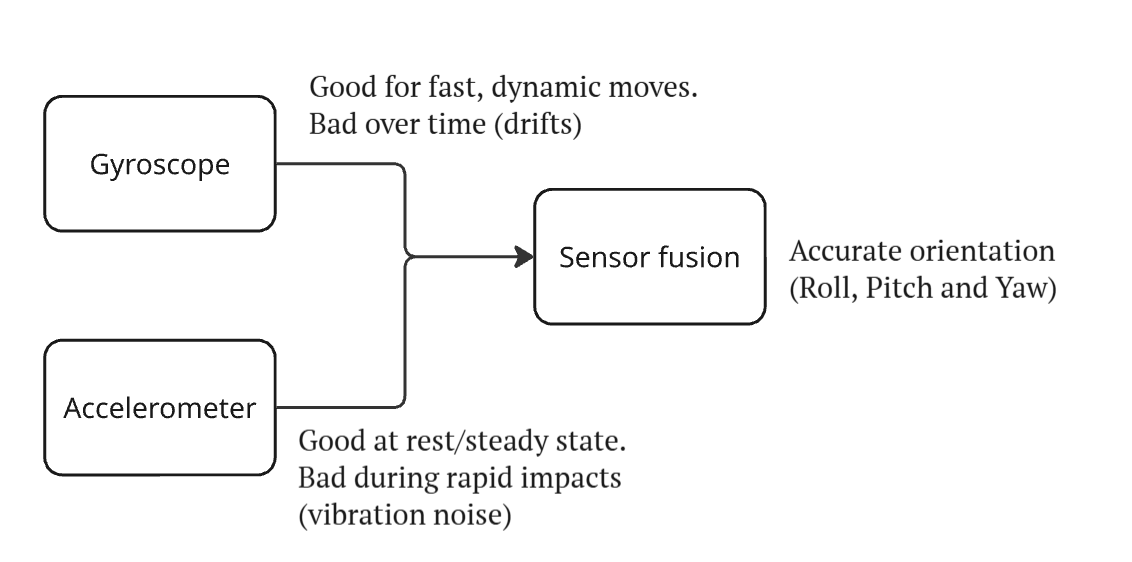
- Short term: the gyroscope is highly accurate. It captures sudden, rapid twists, so the algorithm leans on it over millisecond intervals.
- Long term: integrating gyroscope data accumulates error (gyro drift). The algorithm gradually leans on the accelerometer to find the true gravity vector and the magnetometer to find North, which continuously resets the orientation baseline.
This is why a magnetometer is not mandatory, yet so useful. From the fused data, a system can estimate the sensor’s orientation, velocity, acceleration and relative position.
IMU Sensors in Physiotherapy and Rehabilitation
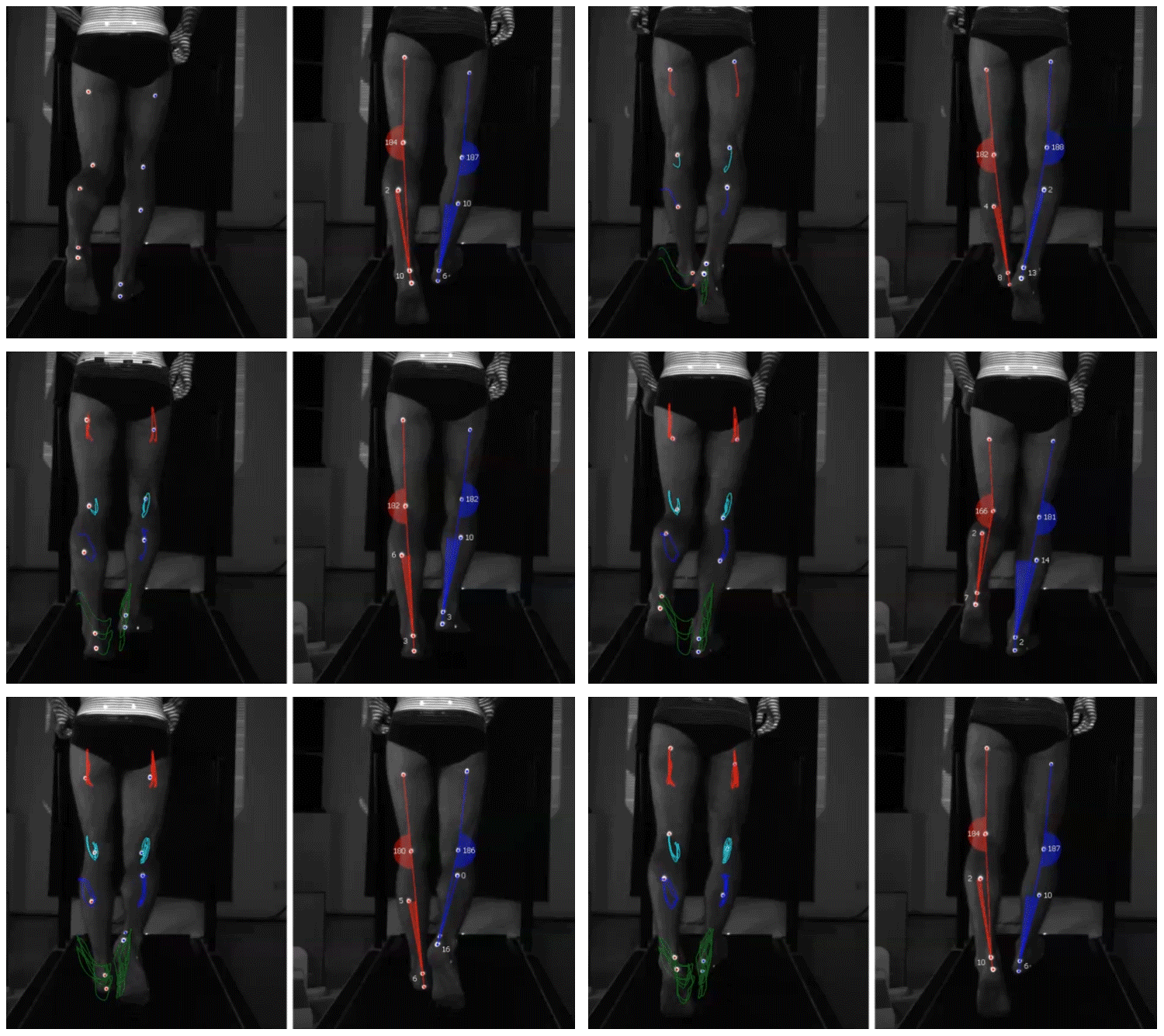
IMUs are used in many fields, but they matter especially in physiotherapy and rehabilitation. Fused IMU data gives clinicians and researchers several critical movement metrics:
- Joint angles: flexion/extension, abduction/adduction and internal/external rotation. Examples include knee flexion during a landing and elbow angles during jumps and stretches.
- Segment orientation: the tilt, pitch and roll of a limb in space.
- Acceleration profiles: peak accelerations that show force absorption, limb behaviour and left-right asymmetries during bilateral tasks.
A caveat: drift
IMUs estimate position by integrating acceleration twice over time, so small measurement errors compound into drift. Good sensor fusion, calibration and short measurement windows keep that error manageable.
Our Use of IMU: Motivus in Blender
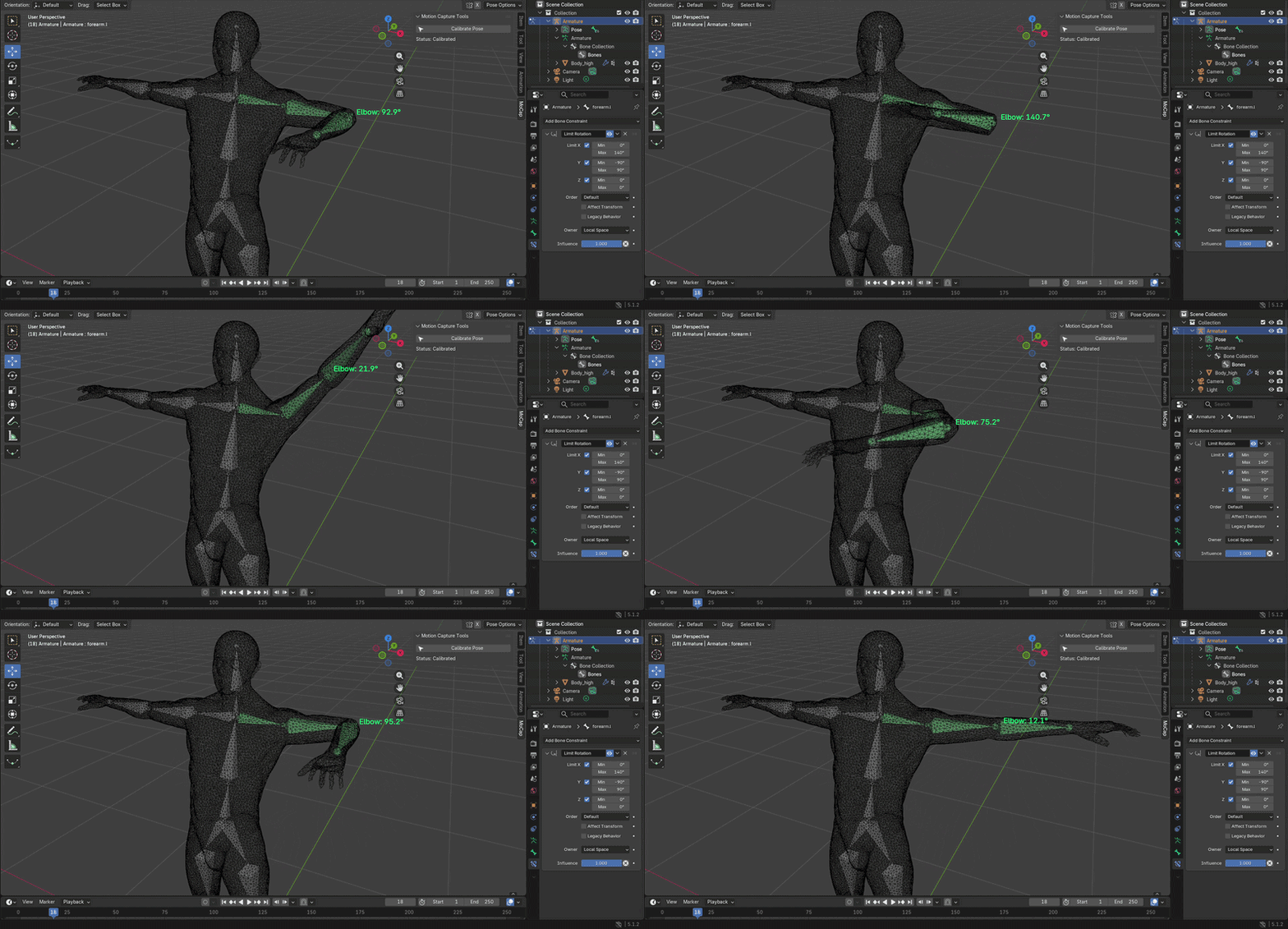
IMU data works well with open-source software such as Blender. To demonstrate this, we use Motivus, a 9-DoF range-of-motion IMU sensor from Medsby with high-fidelity tracking. Its web app also lets you collect the raw movement data, which makes it ideal for research. The result is the live elbow-angle model shown at the top of this article.
Collect movement data from Motivus
Connect to the Motivus Wi-Fi network (motivus_master) and open the web app. It shows all the data for the movement the sensor experiences.
Prepare a rigged human model in Blender
Blender is a free, open-source 3D creation suite that can be scripted with Python. Download a free human model, rig its bones and add a bone rotation limit to each limb so it moves like a real human limb.
Script the live data
Write a Python script that reads the Motivus data (for example via its IP address) and assigns one sensor to each limb. As the sensor moves, the matching bone follows.
Where Else Are IMU Sensors Used?
Beyond rehabilitation, IMUs power drones, VR headsets, autonomous vehicles, sports analytics, robotics and prosthetics. Pairing them with software such as Blender makes movement data easier to see, share and teach with. At Medsby we apply the same sensing ideas in our biomechanics and robotics products.
IMU and Motion-Tracking Solutions from Coimbatore, Tamil Nadu
Medsby is a biomedical and engineering solutions company based in Coimbatore, Tamil Nadu, working with engineering colleges, researchers and innovators across India. If you are a biomedical engineering lab, physiotherapy clinic or student team in Coimbatore, Chennai, Madurai or anywhere in Tamil Nadu looking for a 9-DoF IMU sensor, a motion-capture set-up or hands-on training, our team can help with product guidance, set-up and workshops. Explore our academic lab establishments and industrial training programmes, or see how we support prototypes through our 3D printing services.
Frequently Asked Questions
What is an IMU sensor?
An IMU (inertial measurement unit) is a compact sensor that tracks an object’s orientation, angular velocity and acceleration in 3D space using an accelerometer and a gyroscope, often with a magnetometer.
How does an IMU sensor measure movement?
The accelerometer senses linear acceleration and the gyroscope senses rotation rate. A sensor fusion algorithm, such as a complementary or Kalman filter, combines both (and the magnetometer) into stable roll, pitch and yaw angles.
What is the difference between a 6-DoF and a 9-DoF IMU?
A 6-DoF IMU combines a 3-axis accelerometer and a 3-axis gyroscope. A 9-DoF IMU adds a 3-axis magnetometer, which gives an absolute heading reference and reduces yaw drift.
Why does IMU data drift?
Angles and positions are found by integrating gyroscope and acceleration data over time, so tiny errors accumulate. Sensor fusion with gravity and magnetic-field references keeps orientation drift in check.
Can IMU sensors be used in physiotherapy and rehabilitation?
Yes. IMUs worn on limbs measure joint angles, segment orientation and acceleration profiles, helping clinicians track range of motion and left-right asymmetry during rehabilitation.
Where can I buy a 9-DoF IMU motion sensor in India?
Medsby, based in Coimbatore, Tamil Nadu, offers Motivus, a 9-DoF range-of-motion IMU sensor, with delivery across India.
Does Medsby support IMU projects, workshops and training in Coimbatore and Tamil Nadu?
Medsby is based in Coimbatore and works with engineering colleges, labs and innovators across Tamil Nadu and India through academic lab set-ups, workshops and industrial training. Contact the team to discuss product guidance or training.

Project Engineering Intern, Medsby | Bioengineering student, University of Pittsburgh
Mithuna Saravanan is a bioengineering student at the University of Pittsburgh with a strong interest in biomechanics and medical innovation. At Medsby, she is gaining hands-on experience in engineering and healthcare technology, and she is passionate about learning how engineering can improve human health and movement.

Founder & CEO, Medsby Healthcare & Engineering Solutions
Guruprasandh is the founder of Medsby, a Coimbatore-based manufacturer and technology service provider established in 2014, specializing in wearable technology, healthcare devices, and 3D printing. With over a decade of experience in healthcare technology and engineering, he is committed to knowledge sharing, upskilling, and educational training for students and young innovators.
Keep exploring
Ready to track real movement?
Talk to the Medsby team in Coimbatore about Motivus, motion-tracking set-ups or training for your lab, clinic or college anywhere in India.
View Motivus Talk to our team